
Reach-In Wardrobe Ideas for Tight Spaces

15 March 2025 · 4 min read
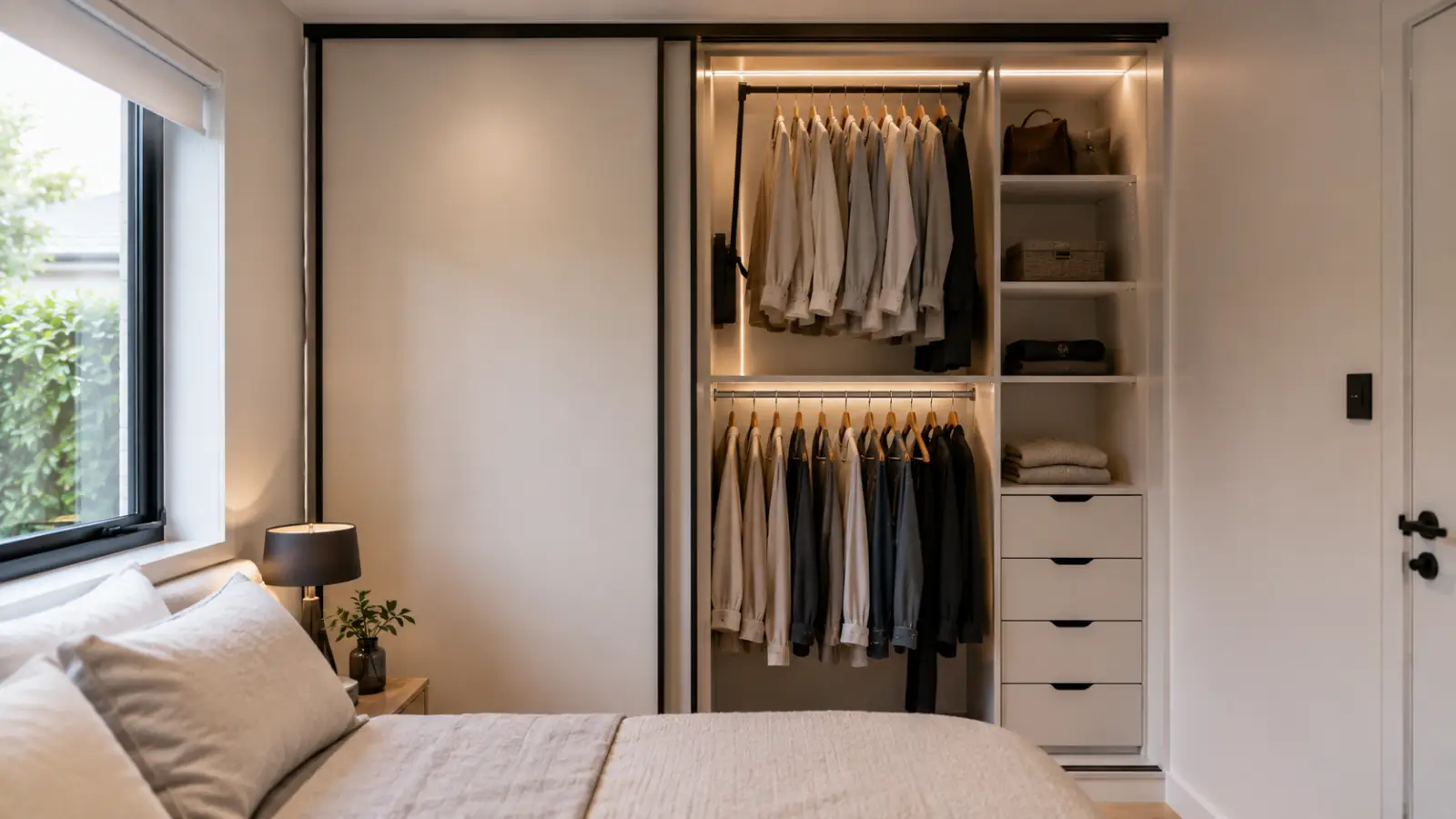
Most reach-in robes I open up in Gisborne homes are half-empty, and not in a good way. There is a single rail floating somewhere near the top, a high shelf collecting suitcases and dust, and a metre of wasted air underneath. The robe is not too small; it is just poorly set out. With some honest planning you can usually double the useful storage without moving a single wall.
Start by Mapping What You Actually Hang
Before talking about clever fittings, I get clients to sort their clothes into two piles: short items (shirts, folded trousers, skirts) and long items (dresses, coats, full-length garments). For most people, short items are the clear majority.
That matters because a standard single rail wastes the lower half of the robe. Once you know your ratio, you can split the space properly instead of guessing.
A few working measurements I use:
- Short hanging needs about 1000mm of height per rail
- Long hanging needs roughly 1500mm to 1650mm
- Shoe shelves want around 180mm to 200mm of clearance
- A comfortable rail sits at shoulder height or just above, not pushed to the ceiling
Double Hanging Is the Biggest Win
The single change that transforms a tight reach-in robe is double hanging: two rails stacked in the section reserved for short items. You hang shirts up top and trousers or skirts below, and suddenly that wasted lower half is doing real work.
In a typical 1800mm to 2100mm high robe you can fit two rails with room to spare. I keep one tall bay for dresses and coats, then double up the rest. For a couple sharing one robe, this is often the difference between cramped and comfortable.
The fastest way to grow a small robe is to stop hanging everything from one rail and split it into short, double-hung sections.
Use the Full Height, Top to Bottom
Gisborne homes vary a lot, from older villas with generous stud heights to newer builds with standard ceilings. Either way, the space above the top rail and below the bottom of your clothes is usually free real estate.
Up high, a fixed shelf or two is perfect for seasonal gear, spare linen and the things you reach for a few times a year. Down low, a bank of drawers or a couple of pull-out shelves keeps folded clothes off the floor.
The trick is to design the carcass to fill the opening properly, right up to the ceiling line, rather than dropping in a freestanding unit that leaves gaps. When we design, build and install a robe in our workshop, we scribe it to your actual walls and floor, so there are no awkward dust traps at the top.
Sliding or Hinged Doors
Door choice depends almost entirely on the room around the robe, not the robe itself.
Hinged doors open fully, so you see and reach everything at once. They are ideal when you have clear floor space in front. The catch is swing room: each door needs roughly its own width of clearance, which is tight in a small Gisborne bedroom where the bed sits close.
Sliding doors need no swing room at all, which makes them the obvious pick for narrow rooms. The trade-off is that one panel always overlaps another, so you can only ever see about two-thirds of the interior at a time. For a wide, shallow reach-in, that is usually a fair deal.
If the robe is genuinely tight and you want full access, an open robe with no doors at all is worth considering. It costs less, looks tidy when well organised, and works nicely behind a bedroom that already has a door.
The Accessories Worth Paying For
Not every gadget earns its place, but a handful genuinely change how a small robe works day to day:
- Internal drawers beat open shelves for socks, underwear and folded knits, and they keep dust out
- Pull-out trouser rails or valet rods make the most of a narrow gap
- A pull-down wardrobe rail brings a high rail within reach without a stool
- Built-in shoe shelves angled slightly forward so pairs sit neatly
- Soft-close runners and hinges, which I fit as standard because cheap hardware is the first thing to fail
My honest advice on cost: spend on the drawers and the hardware, go simpler on the shelving. Solid runners and good hinges are what you notice every single morning, and they are why we back our work with a 5-year workmanship warranty.
A well-planned reach-in robe should make getting dressed feel effortless, even in a small Gisborne bedroom. If yours is fighting you, it is almost always the layout rather than the size.
Sukhman Singh
Founder & Cabinet Maker, Flow Joinery
Sukhman designs and builds bespoke kitchens, wardrobes and cabinetry across Gisborne. Read more →
Reviews
No reviews yet — be the first to share your thoughts.
Sign in or create an account to leave a review.