
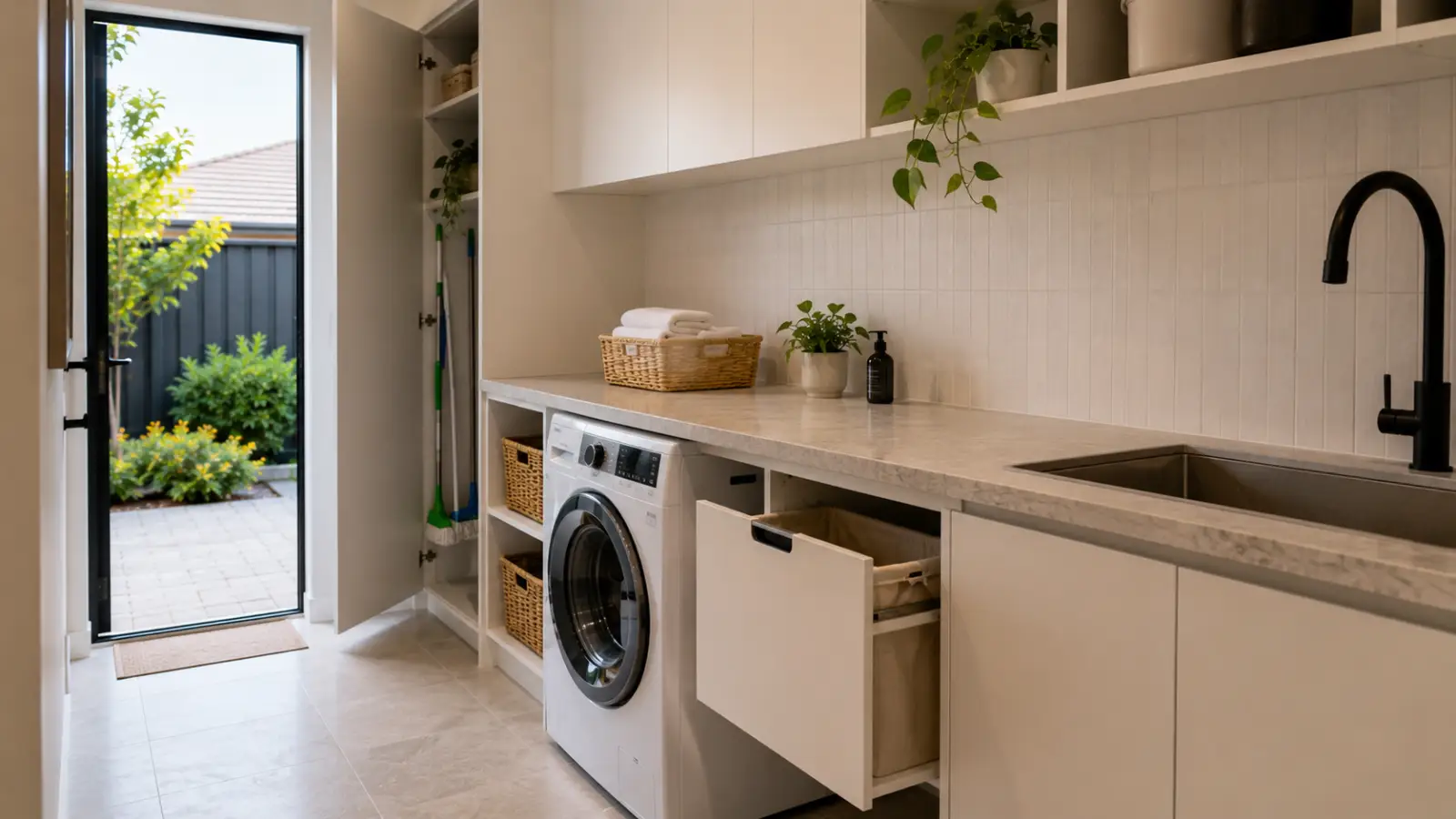
The laundry is the room I see done badly more often than any other in Gisborne homes. It usually gets whatever space is left over after the kitchen and bathroom are planned, then a washing machine is shoved in and everyone wonders why the floor is permanently covered in baskets. With a bit of thought, even a narrow nook can do real work.
Start with the bench, not the machine
Most people plan a laundry around the washer and dryer. I'd flip that. The single most useful thing in a laundry is a flat bench at the right height for sorting and folding, because that's the job you actually do standing up every week.
Aim for a bench around 900mm high, the same as a kitchen worktop, with at least 600mm of clear run beside the sink. If you've got a front-loader, run the bench right over the top of it so the machine tucks underneath. A 600mm-deep laminate or stone offcut over a front-loader gives you a fold zone for free.
If you only get one thing right in a laundry, make it a bench you can fold a sheet on without bending over a basket.
Tall storage earns its keep
Brooms, mops, the vacuum, the ironing board, the spare toilet rolls. They all need a home, and leaning them in a corner isn't one. A full-height broom cupboard, even just 300–400mm wide, swallows the lot and keeps the floor clear.
In our workshop we'll often build a tall unit floor-to-ceiling with:
- A clip rail inside the door for the broom and mop handles
- A high shelf for cleaning sprays away from kids
- A slot wide enough for the ironing board flat against one side
- The vacuum on the floor of the cupboard
Going to the ceiling matters in older Gisborne villas and bungalows with their higher stud heights. That top 400mm is perfect for things you reach once a season.
Hampers and the dirty-clothes problem
Loose baskets multiply. The tidiest solution is built-in hampers on runners, pulled out like a drawer, ideally two so you can sort lights and darks as you go. A pair of 400mm pull-outs under the bench keeps everything off the floor and out of sight.
If space is really tight, a single tilt-out hamper in a 300mm cabinet does the trick. The trade-off is capacity, so for a family I'd push for the wider drawer pair if the layout allows it.
Drying without ruining the room
Gisborne gets good sun, so the line outside does most of the lifting. But we all need a wet-weather backup, and draping wet washing over doors gets old fast. A few options I fit, depending on the space:
- A ceiling-mounted drying rack on a pulley, which lifts clothes up into warm air and out of the way
- A wall-mounted concertina rack that folds flat to about 100mm when you're done
- A heated towel rail or rod for the steady drip of tea towels and small items
Whatever you choose, leave airflow around it. A damp laundry with no ventilation is how you get mould on the ceiling, which is a far bigger problem than a few wrinkled shirts.
Sink and tap placement
A laundry tub is still worth having for soaking, hand-washing and filling buckets, even though the front-loader does most of the work now. Put it at the end of the bench run, not in the middle, so your folding surface stays in one unbroken piece.
A deep 30–40 litre tub is more useful than a shallow one, and a mixer tap with a decent spout height lets you fill a mop bucket without fighting the splashback. If you're plumbing from scratch, group the tub and machine taps together on one wall to keep the pipework and the cost sensible.
Making it all fit
A genuinely useful laundry doesn't need a big room. A run as short as 1.8–2.0 metres can hold a front-loader with bench over, a tall broom cupboard, a tub and pull-out hampers if it's planned tightly. The trick is deciding what each 300mm of width is doing before anything gets built.
That's the part I enjoy. Because we design, build and install everything ourselves, I can measure your actual space, work out the millimetres, and make a cabinet that fits the wall you've got rather than a flatpack that almost does. Every unit we make carries our 5-year workmanship warranty, which matters in a room that gets damp and hard use.
If you're staring at a laundry full of baskets and not sure where to start, come and have a chat. Half an hour with a tape measure usually solves more than you'd think.

Sukhman Singh
Founder & Cabinet Maker, Flow Joinery
Sukhman designs and builds bespoke kitchens, wardrobes and cabinetry across Gisborne. Read more →
Reviews
No reviews yet — be the first to share your thoughts.
Sign in or create an account to leave a review.