
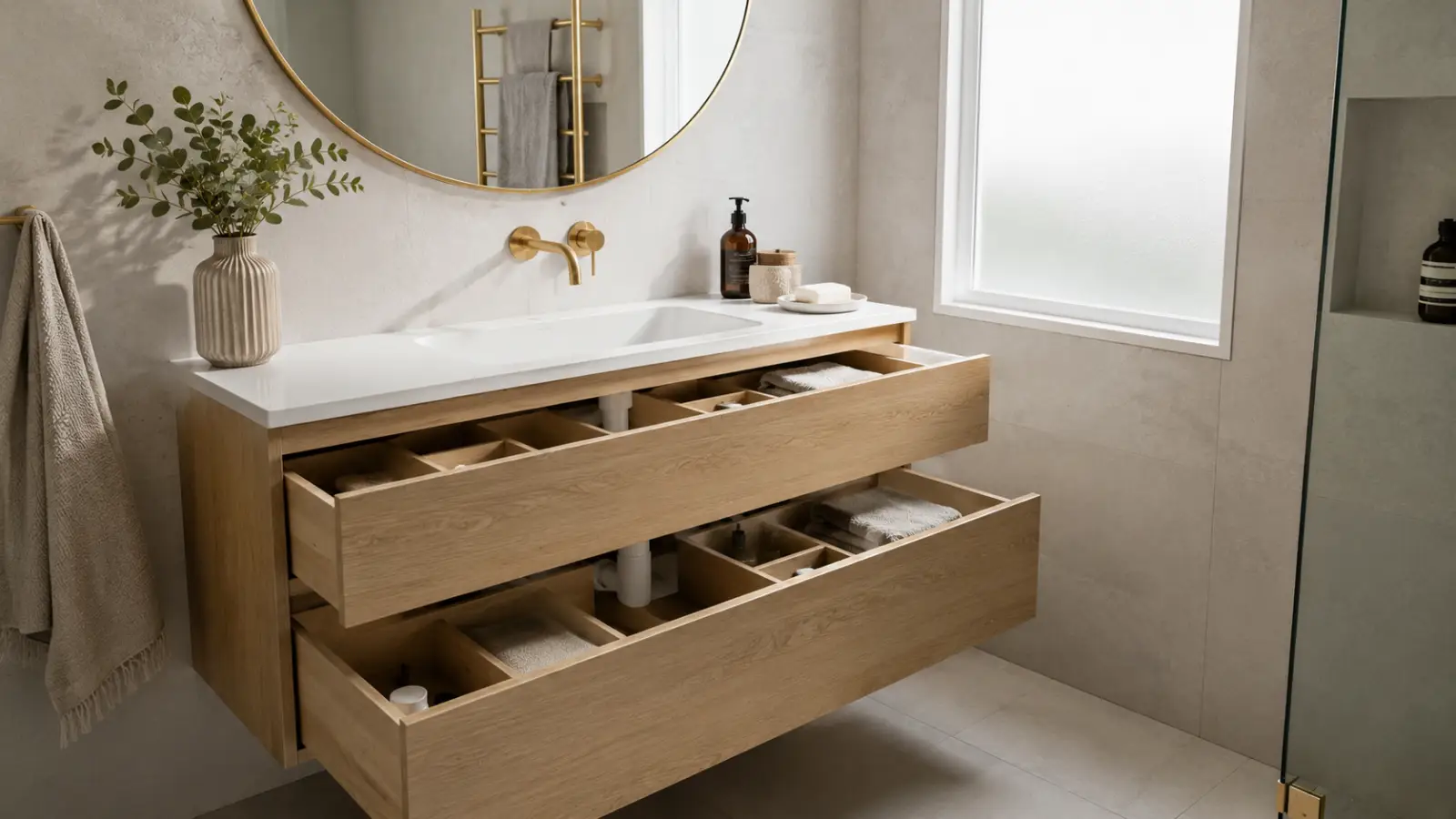
The bathroom is usually the smallest room in a Gisborne home, yet it has to hold the most random collection of stuff: towels, cleaning gear, hairdryers, half-used bottles and the spare toilet rolls nobody has anywhere else for. After building a fair few of them in our workshop, I've found that good storage here isn't about cramming in more cabinetry. It's about making the space you've got work harder.
Drawers beat doors almost every time
If I could give Gisborne homeowners one piece of bathroom advice, it would be this: choose drawers over doors wherever the plumbing allows.
A cupboard with a door means you crouch down, peer into a dark cavity and shuffle things around to find what's at the back. A drawer brings everything to you. You pull it out, you see the lot, and you grab what you need standing up.
A bank of three or four drawers in a 900mm vanity will out-store a hinged cupboard of the same size, simply because you actually use the full depth.
Soft-close runners are standard in everything we build now, and they make a surprising difference in a room where people are often half-asleep. Deep drawers (around 200-250mm internal) are great for bottles and hairdryers, while a shallow top drawer (100-120mm) is perfect for toothbrushes, makeup and the small daily bits.
Working around the plumbing
The catch with drawers is the P-trap and the water supply lines under the basin. These sit right where you'd want full-depth drawers, so we plan around them rather than pretending they aren't there.
A few ways we handle it:
- U-shaped drawers that wrap around the waste pipe, keeping most of the storage while leaving room for the plumbing
- A central door for the pipework with drawers stacked either side, common on a wider double vanity
- Moving the waste to the wall instead of the floor, which frees up the cabinet base (worth raising with your plumber early)
The key is sorting this at the design stage. Once the carcass is built, the pipe location is locked in, so we measure the existing waste and supply positions before a single panel is cut.
Tall cabinets and the mirror combo
When floor space is tight, I look up. A tall cabinet roughly 300-400mm wide, running from bench height to near the ceiling, swallows an astonishing amount of towels and supplies in a footprint smaller than a towel rail.
Above the basin, a mirror cabinet earns its keep. Instead of a plain mirror, you get a recessed or surface-mounted cabinet behind it for medicines, razors and skincare, all hidden but within reach. In older Gisborne villas with deep wall cavities you can sometimes recess it flush, which looks tidy and keeps the cabinet from crowding the room.
Don't forget the dead zones either. The space beside the vanity, the wall above the toilet, the gap at the end of a bath panel can all take a slim cupboard or a few open shelves for rolled towels.
Materials that survive a humid room
Gisborne bathrooms see real moisture, especially smaller ones without great ventilation. The wrong material swells, the edges lift, and within a few years the cabinet looks tired. So material choice matters more here than almost anywhere else in the house.
What I trust for bathroom cabinetry:
- Moisture-resistant MDF (the green-tinged board) for carcasses and painted doors, properly sealed on all edges
- Quality melamine or laminate finishes, which wipe clean and shrug off splashes
- Aluminium or stainless hardware and handles that won't corrode in the damp
- Solid timber only where it's well sealed, since bare timber and steam don't mix long-term
Whatever the finish, the detail that really matters is edge sealing. Water finds any exposed edge, so we band and seal everything that could meet a splash. Pair good materials with an extractor fan that actually vents outside, and your cabinetry will go the distance. It's part of why we're comfortable backing our work with a 5-year workmanship warranty.
A sensible word on cost
Drawers cost more than doors because of the runners and the extra joinery, and a mirror cabinet sits above a plain mirror on price. That said, the difference across a single vanity is usually modest next to the daily benefit. If the budget is tight, I'd spend it on drawers and good moisture-resistant materials first, and keep the finishes simple.
Because we design, build and install locally, we can shape a vanity around your exact plumbing, your wall cavities and how your household actually uses the room, rather than forcing a flat-pack box to fit.
If you're planning a bathroom and want to get the storage right from the start, that planning stage is the moment to think it through.

Sukhman Singh
Founder & Cabinet Maker, Flow Joinery
Sukhman designs and builds bespoke kitchens, wardrobes and cabinetry across Gisborne. Read more →
Reviews
No reviews yet — be the first to share your thoughts.
Sign in or create an account to leave a review.