
Home Office Built-Ins & Desk Storage Ideas

15 December 2025 · 4 min read
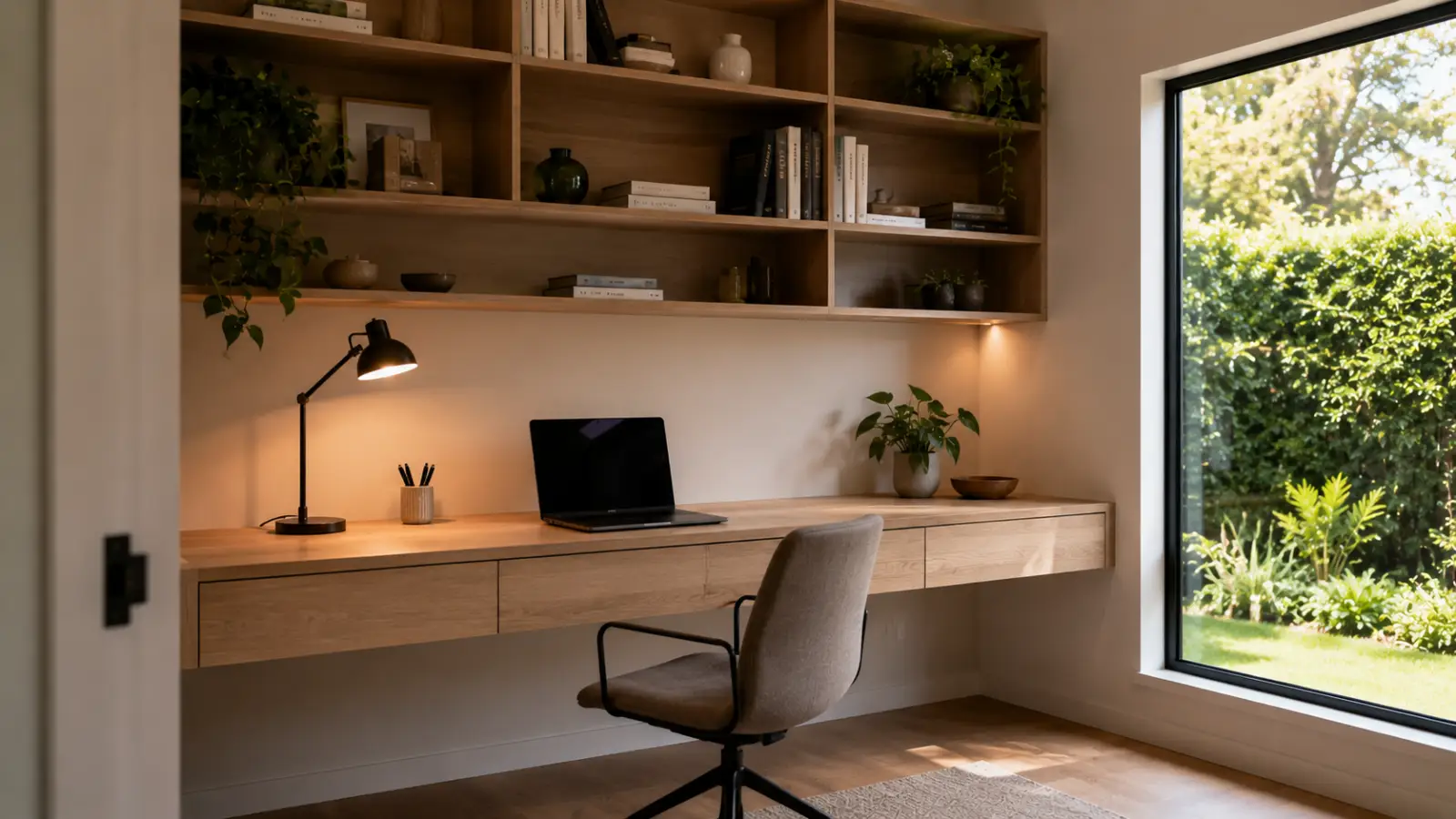
Working from home has quietly become part of life for a lot of Gisborne families, and the laptop-on-the-dining-table phase wears thin pretty fast. A proper built-in office turns an awkward spare room or hallway nook into a space that actually works. Over the years I've fitted a fair few of these, and the difference between one that feels good and one that frustrates you every day usually comes down to a handful of measurements and decisions.
Get the desk height and depth right first
This is where most DIY setups go wrong. A standard desk height of around 720mm to 740mm suits most people sitting in a typical office chair. If you're tall, push toward 750mm; if the desk will be shared with kids doing homework, I'd sit closer to 720mm.
Depth matters just as much. For a single monitor you want a benchtop at least 600mm deep so the screen sits a comfortable arm's length away. Going to 700mm or more is genuinely better if you've got dual monitors or like a clear bit of bench to write on. Anything shallower than 550mm and you'll feel cramped, with the screen too close to your eyes.
If more than one person uses the space, consider a section of bench at standing height too. It breaks up a long day and is easy to design in from the start.
Sorting cables before they become a nightmare
Cable chaos is the thing people complain about most, and it's completely avoidable when the joinery is built around it. A few things I build in as standard:
- A cable port or grommet through the benchtop, ideally near a back corner
- A hidden cable tray or rail fixed under the rear of the desk to hold the power board and excess lead
- A dedicated power point inside the desk return, not down at the skirting board
- A small gap (10-20mm) left behind the bench against the wall so cords can drop cleanly
Plan power and data points before the cabinetry goes in. Retrofitting a tidy cable run after the fact is always more work and never as neat.
It's worth talking to your sparky early so the points land exactly where the joinery needs them.
Drawers versus shelves: what goes where
People often default to open shelving because it's cheaper and looks light, but a home office runs on a mix. My rough rule:
Drawers earn their place for the things you handle daily and want out of sight, stationery, chargers, notebooks, the stuff that otherwise colonises the benchtop. A couple of shallow 100mm drawers plus one deeper file drawer covers most people. If you keep paperwork, a drawer sized for A4 suspension files (around 360mm internal) saves you buying a separate filing cabinet.
Open shelves suit reference books, folders you reach for often, and a bit of personality, plants, photos, that sort of thing. Adjustable shelves on pins are worth it; your needs will change.
For Gisborne homes where the office often shares a guest room or living space, I lean toward more closed storage so the room still reads as tidy when you shut the laptop.
Printers, routers and the cupboard that hides them
Nobody wants to look at a printer all day. A printer cupboard with a pull-out shelf on runners lets you slide the machine forward to load paper or clear a jam, then push it back out of sight. Leave ventilation gaps and a cable pass-through at the rear so it can stay plugged in.
Same thinking applies to the modem and router, but those need a little airflow and shouldn't be sealed in a tight box, a vented cupboard or a back panel cut-out does the job. I usually allow a generous power-point cluster in these cupboards so everything charges and runs in one tidy spot.
Fitting a nook or spare room
The best built-in offices use space that's otherwise wasted. A recessed nook, the end of a hallway, the dead space under a staircase, or an alcove beside a chimney breast can all take a fitted desk run when freestanding furniture wouldn't fit. Built-ins shine here because we scribe them to your walls, which are rarely square in older Gisborne villas and bungalows.
For a full spare room, a wall-to-wall run with overhead cupboards gives you serious storage without eating floor space, and you can still tuck a sofa bed in for guests.
Because we design, build and install everything ourselves locally, we can shape the whole thing around your room and how you actually work, and back it with our 5-year workmanship warranty. If you're weighing it up, a built-in usually costs more than flat-pack but less than people expect, and it lasts far longer, so it's worth getting honest measurements and a rough range before deciding.
Whatever you're planning, measure your space and think about how you really use it before anything gets cut, that's where a good office starts.
Sukhman Singh
Founder & Cabinet Maker, Flow Joinery
Sukhman designs and builds bespoke kitchens, wardrobes and cabinetry across Gisborne. Read more →
Reviews
No reviews yet — be the first to share your thoughts.
Sign in or create an account to leave a review.