
Hallway & Linen Cupboard Storage Solutions

15 September 2025 · 4 min read
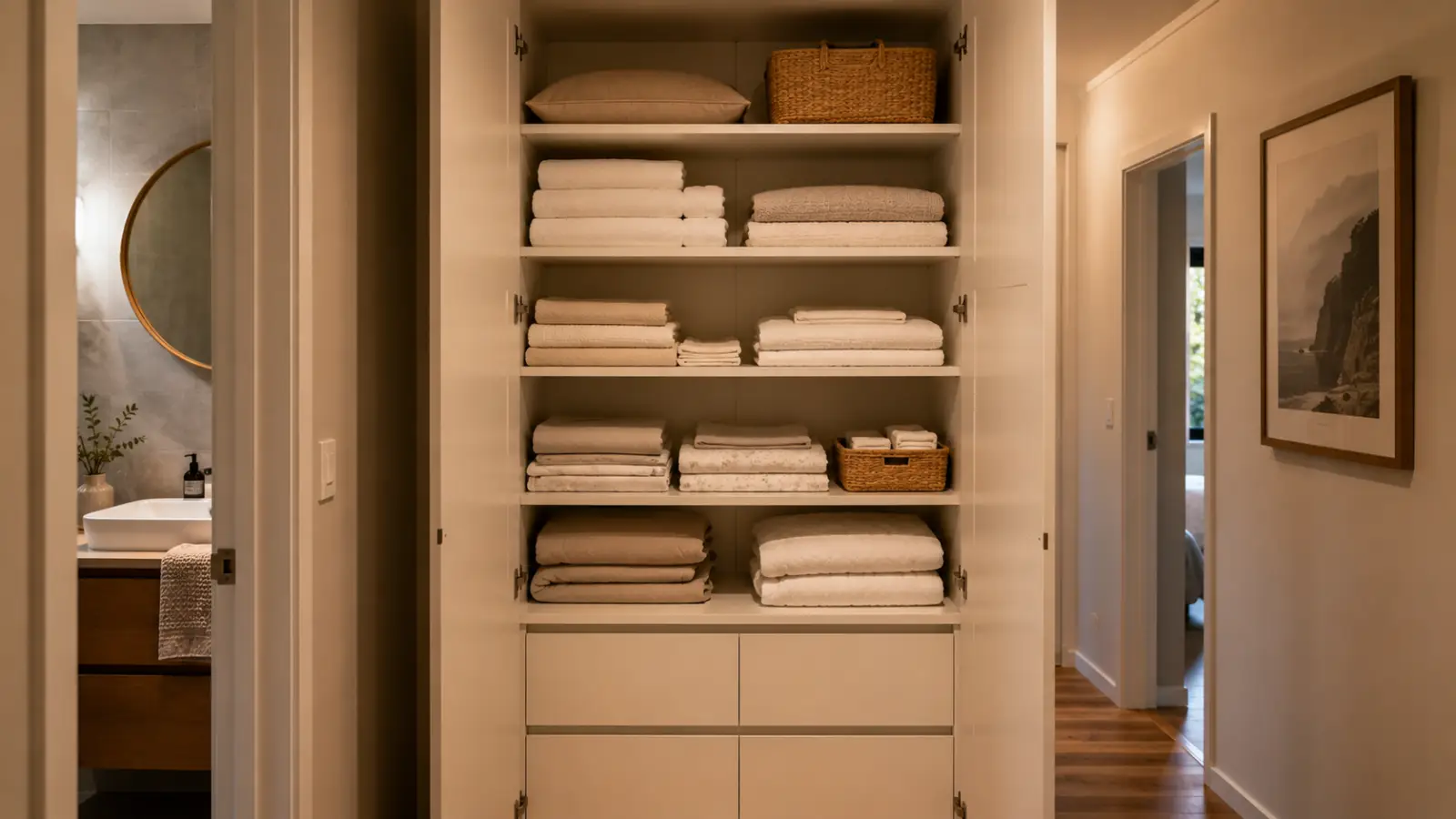
Most of the linen cupboards I open in Gisborne homes are doing about half the job they could. Fixed shelves spaced too far apart, a deep top shelf nobody can reach, and towels stacked so high they topple every time you pull one out. The good news is that the space is almost always there — it just needs reorganising properly.
Start With Adjustable Shelving
The single biggest improvement to most linen cupboards is swapping fixed shelves for adjustable ones. Older Gisborne homes often have shelves nailed in at builder-standard spacing, which rarely matches what you actually store.
In our workshop we set linen cupboards up on a system of holes drilled at 32mm increments, so shelves move up or down as your needs change. A few sensible guidelines:
- Allow roughly 300–350mm between shelves for folded towels and bed linen.
- Keep one or two shorter gaps (around 200mm) for face cloths, hand towels and toiletries.
- Leave a taller bay at the bottom for laundry baskets, vacuum cleaners or bulky duvets.
Get the spacing right and you stop wasting the dead air above each stack — which is usually where a third of the cupboard's capacity hides.
Shallow vs Deep: Match Depth to Contents
Depth is where a lot of cupboards go wrong. A standard linen cupboard is often 550–600mm deep, which sounds generous until you realise anything pushed to the back is forgotten for a year.
For folded linen, a depth of around 400mm is the sweet spot — deep enough for a stack of towels, shallow enough that nothing disappears. If your existing cupboard is deeper than that, the back portion is better served by pull-outs than by another fixed shelf.
A shallow shelf you can see beats a deep shelf you forget. Always store to the depth you can comfortably reach.
Shallow shelves near the door also suit smaller items — first-aid kit, spare toiletries, cleaning sprays — that otherwise get lost behind the towels.
Pull-Outs for the Deep and the Dead Zones
Where a cupboard is genuinely deep, pull-out shelves or wire baskets earn their keep. Instead of digging to the back, you slide the whole shelf out and see everything at once.
We fit these on full-extension runners so the shelf comes right out past the door frame. They work especially well for:
- Spare bedding and seasonal blankets you only reach for a few times a year.
- A laundry zone with two stacked baskets — one for darks, one for lights.
- Cleaning supplies, where a pull-out keeps bottles upright and visible.
The same thinking rescues that awkward top shelf. Rather than leaving it as an unreachable ledge, we can box it into a clearly defined zone for things you genuinely store long-term, and add a step recess or keep a stool nearby. Honest cost note here: pull-outs and runners do add to the price compared with plain melamine shelves, so I usually suggest putting them only where the depth or daily use justifies them, and keeping simpler fixed shelving elsewhere.
Zone and Label So It Stays Tidy
A reorganised cupboard only stays organised if everyone in the house knows where things go. I'm a big believer in labelled zones — towels here, sheets by bed size there, guest linen up high.
Simple habits that hold up over time:
- Group bed linen by room or bed size so you grab a matched set in one go.
- Keep an "everyday" zone at eye and waist height; push rarely-used items higher or lower.
- Store full sheet sets inside one of their own pillowcases — the whole set stays together.
This costs nothing and makes the difference between a system that works for a fortnight and one that still works in two years.
Turning Dead Hallway Space Into Storage
Gisborne hallways are often wider than they need to be, and that spare width is prime storage. Even 250–300mm of depth along a hallway wall is enough for a run of shallow cabinetry — perfect for linen, shoes, or a tidy spot for school bags and sports gear.
Because we design, build and install everything ourselves, we can shape cabinetry to fit the exact wall, skirting and ceiling line of your home rather than forcing in a standard flat-pack unit. A few options that suit our local homes:
- A floor-to-ceiling shallow cupboard that reads as part of the wall.
- A bench seat with linen storage underneath, handy near an entry.
- Recessing storage into an unused nook or the space beside a doorway.
Whatever we build, it's backed by our 5-year workmanship warranty, so the runners, hinges and shelves are made to keep working as hard as the day they went in.
If your linen cupboard is overflowing while half its volume sits empty, the fix is usually smarter shelving rather than more square metres. Have a proper look at yours this weekend — you might be surprised how much room is already there.
Sukhman Singh
Founder & Cabinet Maker, Flow Joinery
Sukhman designs and builds bespoke kitchens, wardrobes and cabinetry across Gisborne. Read more →
Reviews
No reviews yet — be the first to share your thoughts.
Sign in or create an account to leave a review.