
Display Shelving & Feature Joinery for Living Rooms

3 April 2026 · 4 min read
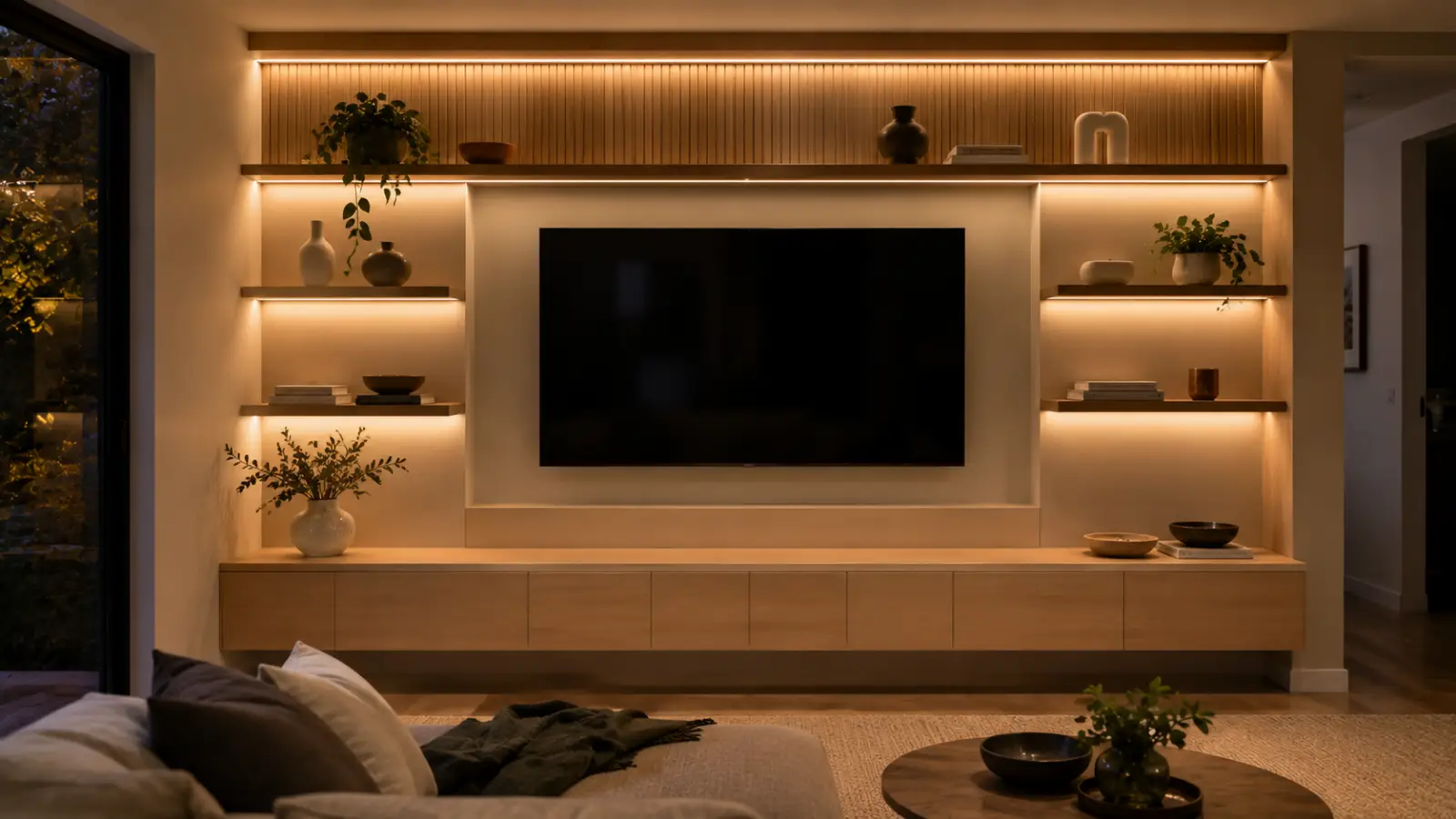
The living room is where most of us spend our evenings, and it is also where the clutter quietly piles up: remotes, kids' books, the gaming console, that growing tangle of cables behind the TV. Good joinery solves both problems at once, giving you somewhere to display the things you love while hiding the things you would rather not see. After years of building these for families across Gisborne, here is how I think about getting the balance right.
Start with the wall, not the TV
The most common mistake I see is designing around the television first. A media wall works far better when you plan it as one continuous piece of joinery and let the screen sit within it, rather than treating the TV as the hero and squeezing storage around the edges.
Measure the full wall and think about it in three bands: a low run of concealed storage at floor level, a clean middle zone for the screen, and lighter shelving or open display up high. This layering reads calmly even on a busy wall, and it suits the open-plan living areas common in newer Gisborne builds where the living room flows straight into the kitchen and dining.
If you have a heat pump head or a window eating into the wall, tell your joiner early. We can often step the cabinetry around these so it still looks deliberate rather than awkwardly cut off.
Concealed versus open: get the ratio right
Open shelving looks great in photos, but a living room that is all open shelving becomes a dusting chore and a visual jumble within a month. The trick is ratio.
As a rough rule I aim for around two-thirds concealed storage to one-third open display. The closed cabinets swallow the messy reality of family life, while the open sections become curated spots for a few books, a plant, a framed photo.
- Drawers beat doors for low storage. They bring everything to you instead of making you kneel and reach into a dark cupboard.
- Push-to-open doors and drawers let you skip handles entirely for a seamless, modern face.
- Adjustable shelves inside cabinets matter more than people expect, because what you store changes over the years.
If you only remember one thing: hide the clutter, display the few things you genuinely love, and resist filling every shelf.
Floating shelves that actually hold weight
Floating shelves are deceptively tricky. A thin shelf with a heavy stack of hardcovers will sag or pull away from the wall over time if it is not built and fixed properly.
For a solid result we use a concealed steel bracket or batten fixed back into framing or solid blocking, then build the shelf around it. A floating shelf around 38 to 50mm thick looks substantial without feeling chunky, and that depth gives us room to hide the support. Depth-wise, 250 to 300mm suits most display pieces and books while keeping the shelf from dominating the room.
In Gisborne's climate I generally steer people away from raw timber shelves in rooms that get strong afternoon sun, as movement and fading show up faster. Engineered panels with a quality finish, or well-sealed solid timber, hold up better.
Cable management and integrated lighting
Nothing undoes a beautiful media wall like a fistful of visible cables. We plan cable runs before a single panel is cut: conduit through the cabinetry, a ventilated compartment for the receiver or console so it does not overheat, and a power point positioned behind the unit rather than beside it.
Lighting is what lifts feature joinery from functional to genuinely special. A few options worth considering:
- LED strips tucked under floating shelves to wash light down the wall.
- Recessed lighting inside open display niches to highlight objects.
- A warm colour temperature, around 2700 to 3000K, which feels right for relaxing rather than the cold light of a workspace.
Put these on a dimmer. The same wall can be a bright, practical space in the daytime and a soft, layered feature in the evening.
A note on cost and getting it built
Feature joinery covers a wide range. A simple run of floating shelves sits at the affordable end, while a full floor-to-ceiling media wall with concealed storage and integrated lighting is a more significant investment. The honest answer on price always depends on size, materials and finish, so it is worth getting a proper measure and quote rather than guessing from a number online.
Because we design, build and install everything here in our own workshop, we can tailor the piece to your exact wall and the way your family actually lives, and every job is backed by our 5-year workmanship warranty.
If you are picturing what your living room could become, that is the fun part, and it is always easier to talk it through with measurements in front of us.
Sukhman Singh
Founder & Cabinet Maker, Flow Joinery
Sukhman designs and builds bespoke kitchens, wardrobes and cabinetry across Gisborne. Read more →
Reviews
No reviews yet — be the first to share your thoughts.
Sign in or create an account to leave a review.