
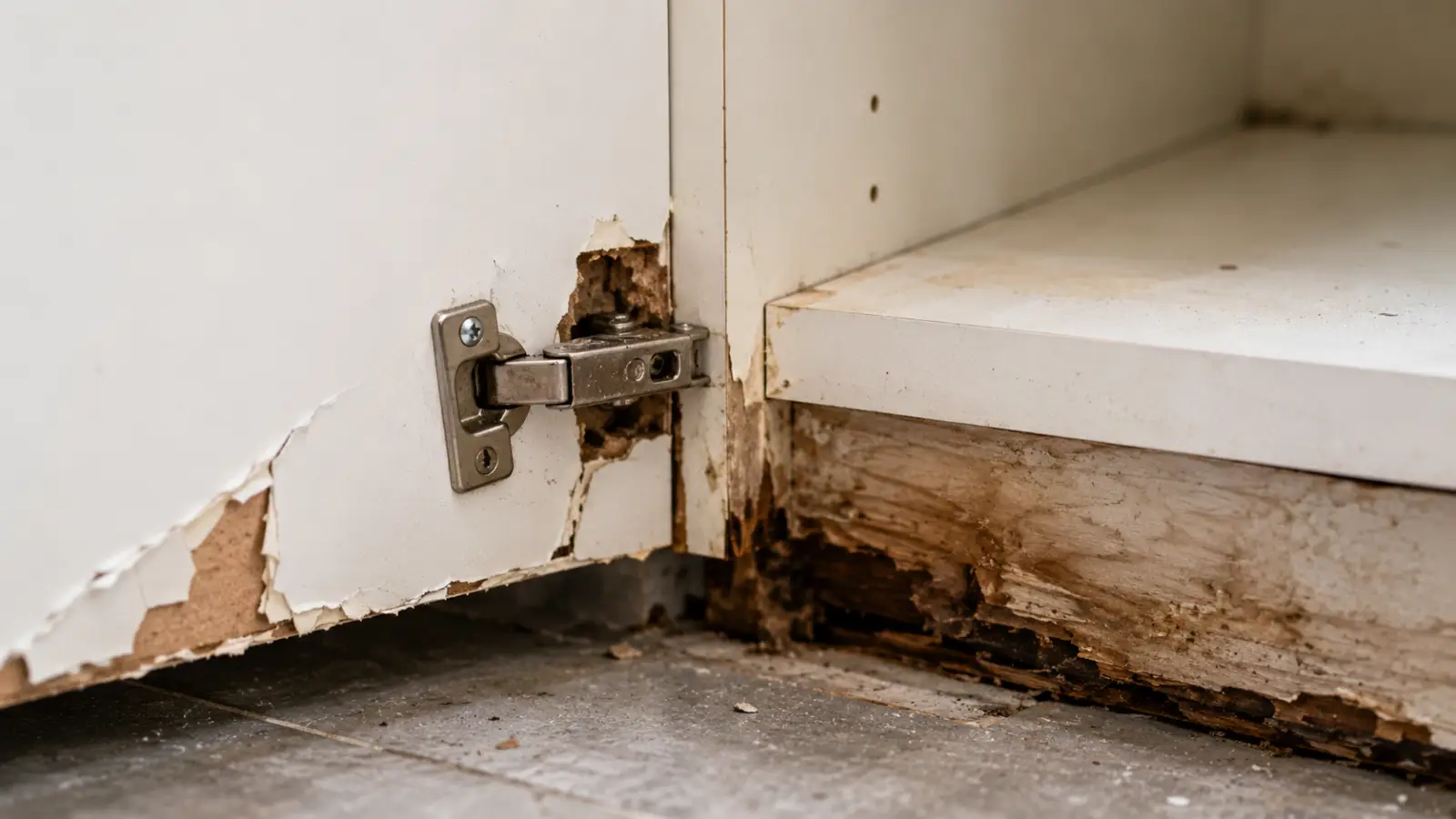
Every now and then someone rings the workshop wanting us to repair a kitchen that's only five or six years old. The doors won't sit straight, a shelf has bowed under the weight of the dinner plates, and the cabinet under the sink has swollen up like a sponge. Nine times out of ten, it was the cheapest quote at the time.
Where The Money Quietly Disappears
A cheap kitchen isn't usually cheaper because someone found a clever shortcut. It's cheaper because the materials and hardware are lighter, thinner and less durable. You don't notice the difference on installation day, when everything is new and square. You notice it two or three winters later.
The most common failures I see come down to a handful of things:
- Swelling MDF or low-grade particle board around the sink, dishwasher and kettle, where steam and the odd spill get into unsealed edges.
- Sagging shelves, usually 16mm board run too wide with no support, slowly drooping in the middle.
- Failing hinges and runners that were the cheapest available, so doors drop and drawers stop closing flush.
- Poor fit against walls and floors that are never perfectly straight, leaving gaps that collect crumbs and look unfinished.
None of these are dramatic on their own. Together, they turn a kitchen you were proud of into one you apologise for.
Moisture Is The Real Enemy In A Gisborne Kitchen
Our climate here doesn't do cheap cabinetry any favours. We get genuine humidity through summer, and a kitchen is the dampest room in most homes anyway. Standard raw particle board acts like a wick: once water finds an unsealed edge or a screw hole, it draws moisture in and the board puffs up permanently. There's no fixing it once it swells.
Better cabinetry uses moisture-resistant (MR) board, properly sealed edges, and sometimes a different substrate entirely under the sink. It costs a bit more per sheet, but it's the difference between a carcass that lasts decades and one that's soft to the touch by the time the kids leave home.
The cheapest kitchen and the dearest kitchen often look identical in the showroom. The gap only shows up once they've lived through a few of our summers.
What Quality Actually Looks Like
Quality isn't about flashy handles or the most expensive stone on the bench. It's mostly in the parts you can't see once the doors are shut. When you're comparing options, here's where to actually look:
- Carcass thickness. A solid cabinet box is typically 18mm rather than 16mm, and the back panel is set into a groove, not just stapled on.
- Shelf spans. Shelves longer than about 800mm need thicker board or a centre support, otherwise they will sag eventually. Ask how wide the unsupported runs are.
- Hardware brand. Good soft-close hinges and drawer runners are a known quantity and rated for years of daily use. Cheap unbranded versions are the first thing to fail.
- Edge sealing. Run your finger along the edges around wet zones. They should be fully sealed, not raw or chipped.
- Scribing and fit. A good installer cuts cabinets and fillers to follow the wall, so there are no ugly gaps. This is craft, not luck.
If a quote can't tell you these things, that's usually your answer.
Cheap Twice, Or Right Once
Here's the maths that matters. If a budget kitchen needs replacing or heavily repairing in eight to ten years, while a well-built one comfortably lasts twenty-plus, the cheaper kitchen isn't cheaper at all. You've paid for two kitchens plus the disruption, the second time at higher prices.
I won't put fake dollar figures on that, because every job is different. But as a rule of thumb, the quality carcass, hardware and proper sealing might add somewhere in the order of ten to twenty percent over the bottom-of-the-market option. That's a modest premium against doing the whole thing again.
It's also why we build and install our kitchens ourselves here in Gisborne rather than flat-packing someone else's boxes, and why we stand behind the work with a 5-year workmanship warranty. When you make it and fit it, you have to get it right.
Spending Smarter, Not Just More
None of this means you have to chase the dearest kitchen in town. The smartest approach is to put your money into the bones, the carcass, the hinges, the runners, the sealing, and be more relaxed about the finishes you can change later. A solid box with a modest door front will outlast a fancy door on a flimsy carcass every time.
If you're weighing up quotes and not sure what you're really comparing, it's worth getting someone to walk you through where the differences actually sit. Better to ask the awkward questions now than to be ringing a joiner in six years to pull it all out.

Sukhman Singh
Founder & Cabinet Maker, Flow Joinery
Sukhman designs and builds bespoke kitchens, wardrobes and cabinetry across Gisborne. Read more →
Reviews
No reviews yet — be the first to share your thoughts.
Sign in or create an account to leave a review.