
Soft-Close Drawers & Quality Hardware: Worth It?

8 January 2026 · 4 min read
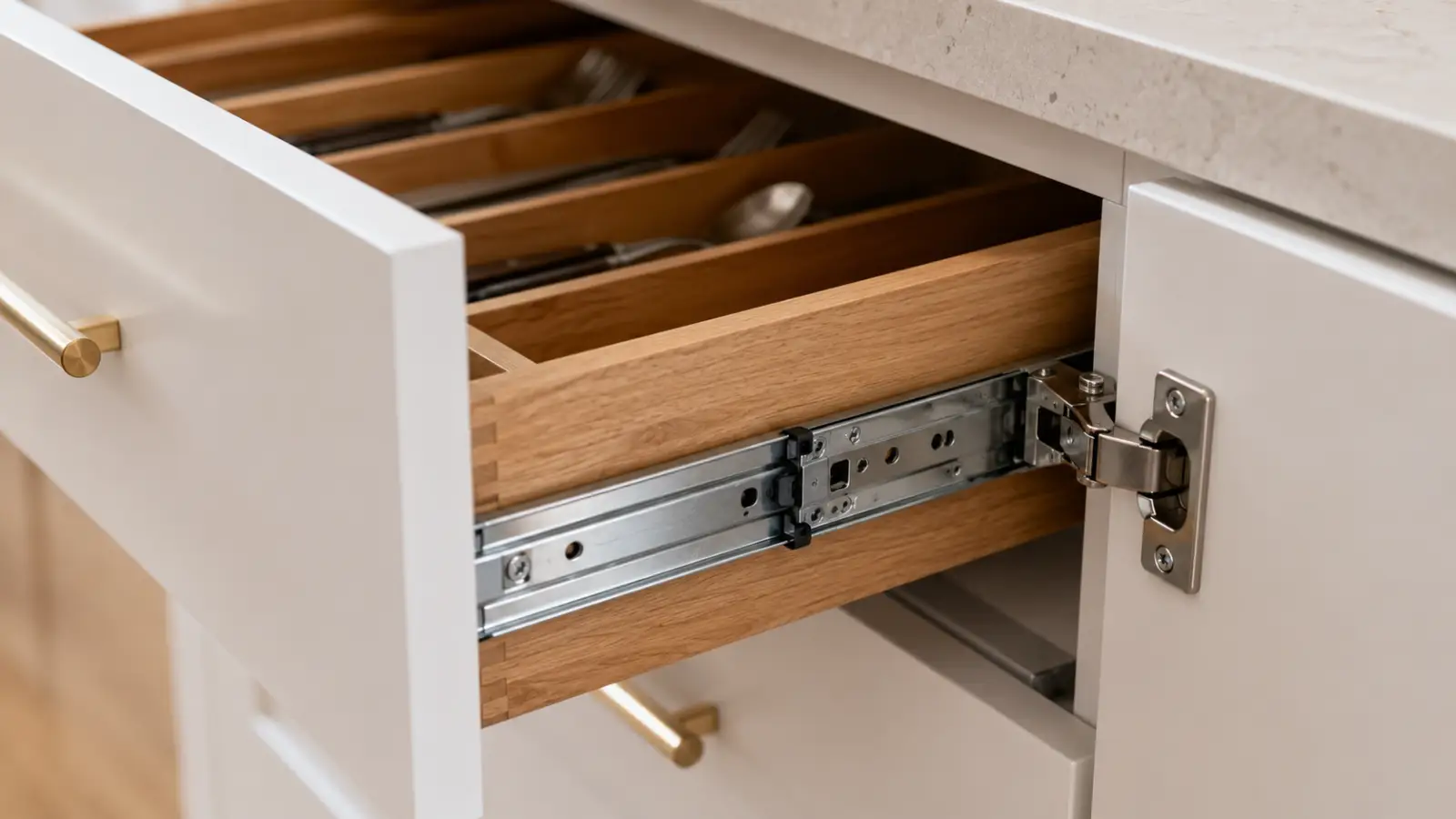
When people plan a new kitchen, they obsess over benchtops, colour and the splashback. The hardware hiding inside the cabinets barely gets a mention. But after years of building and installing kitchens around Gisborne, I can tell you the hinges and drawer runners are the parts you'll touch a hundred times a week, and they're the first thing to fail in a cheap kitchen.
Why the hardware matters more than the doors
A kitchen door or drawer front is mostly cosmetic. The runners and hinges are what carry the load, take the abuse, and decide whether your kitchen still feels solid in ten years.
Think about how a drawer gets used. Loaded with pots, yanked open, shoved shut with a hip because your hands are full. That happens thousands of times a year. Bargain runners use thin steel and plastic rollers that wear, sag and eventually drag. Good runners use ball-bearing slides that glide the same on day one and day three thousand.
The doors and fronts you see are the easy part. The mechanism behind them is where a kitchen quietly earns its keep or quietly lets you down.
What "soft-close" actually does
Soft-close isn't just about the satisfying gentle shut. The mechanism is a small hydraulic damper that catches the drawer or door in the last few centimetres and eases it home.
That does three useful things:
- Stops slamming, which protects the joinery from the constant shock that loosens joints over time
- Removes pinched fingers, genuinely worth it with young kids in the house
- Keeps fronts aligned, because slamming is what knocks doors out of true and creates uneven gaps
Soft-close isn't a luxury feature. It's the thing that keeps the rest of your cabinetry from shaking itself loose over a decade of daily use.
Weight ratings and why they're not just a number
Every runner has a weight rating, usually 25kg, 40kg or more per drawer. People assume the small top cutlery drawer and the big pot drawer can run on the same hardware. They can't, or rather they shouldn't.
A deep pot drawer full of cast iron and stacked crockery can easily push past 30kg. Put that on a 25kg runner and it'll work fine at first, then start to sag and bind within a couple of years. We spec runners to the actual job: lighter slides up top, heavy-duty full-extension runners on the deep pot and pantry drawers.
Full-extension matters too. Cheaper partial-extension runners leave the back 100mm or so of the drawer tucked under the bench, which is exactly where things get lost. Full-extension pulls the whole drawer clear so you can reach the back without crouching and digging.
The brands that justify the spend
I won't pretend every premium label is worth chasing, but two names genuinely earn their reputation, and we fit them as standard.
Blum (Austrian) and Hettich (German) make the runners, hinges and soft-close mechanisms we rely on. The difference isn't marketing. It's the consistency of the action, the weight ratings holding up under real load, and the warranties behind them, often lifetime mechanical guarantees on the moving parts.
What you're paying for:
- Dampers that still feel smooth years in, not stiff or sloppy
- Easy three-way adjustment so doors can be re-aligned in seconds without removing anything
- Real spare-part availability, so a clip or damper can be swapped rather than the whole drawer
That last point matters here in Gisborne. We're a fair way from the big centres, and a mainstream brand means parts are easy to get rather than a discontinued mystery fitting from an importer who's moved on.
Where I'd spend and where I'd hold back
Hardware is one place I always tell homeowners not to cut corners, but you don't need to gold-plate every cabinet either.
Spend properly on the drawers and the hinges because that's where wear, weight and daily use concentrate. The runners under your pot drawers and the hinges on your most-used doors are the parts that fail first when they're cheap.
Where you can ease off: you don't need internal LED lighting, fancy corner carousels or pull-out spice racks in every run. Those are nice, but they're add-ons, not the bones. Get the core mechanisms right first.
As a rough guide, upgrading from budget hardware to quality soft-close across a full kitchen adds a noticeable but not enormous amount to the overall job. It's a small slice of the total spend for the part you interact with most. I've never had a client regret it, and I've replaced plenty of failed cheap runners for people who wish they'd done it the first time.
Because we design, build and install our kitchens here ourselves, the hardware we choose is backed by our 5-year workmanship warranty, and we know exactly what's going behind every front.
If you're weighing up where your kitchen budget should go, put the hardware near the top of the list. It's the part you'll quietly thank yourself for every single day.
Sukhman Singh
Founder & Cabinet Maker, Flow Joinery
Sukhman designs and builds bespoke kitchens, wardrobes and cabinetry across Gisborne. Read more →
Reviews
No reviews yet — be the first to share your thoughts.
Sign in or create an account to leave a review.