
Choosing the Right Splashback for Your Kitchen

15 October 2025 · 4 min read
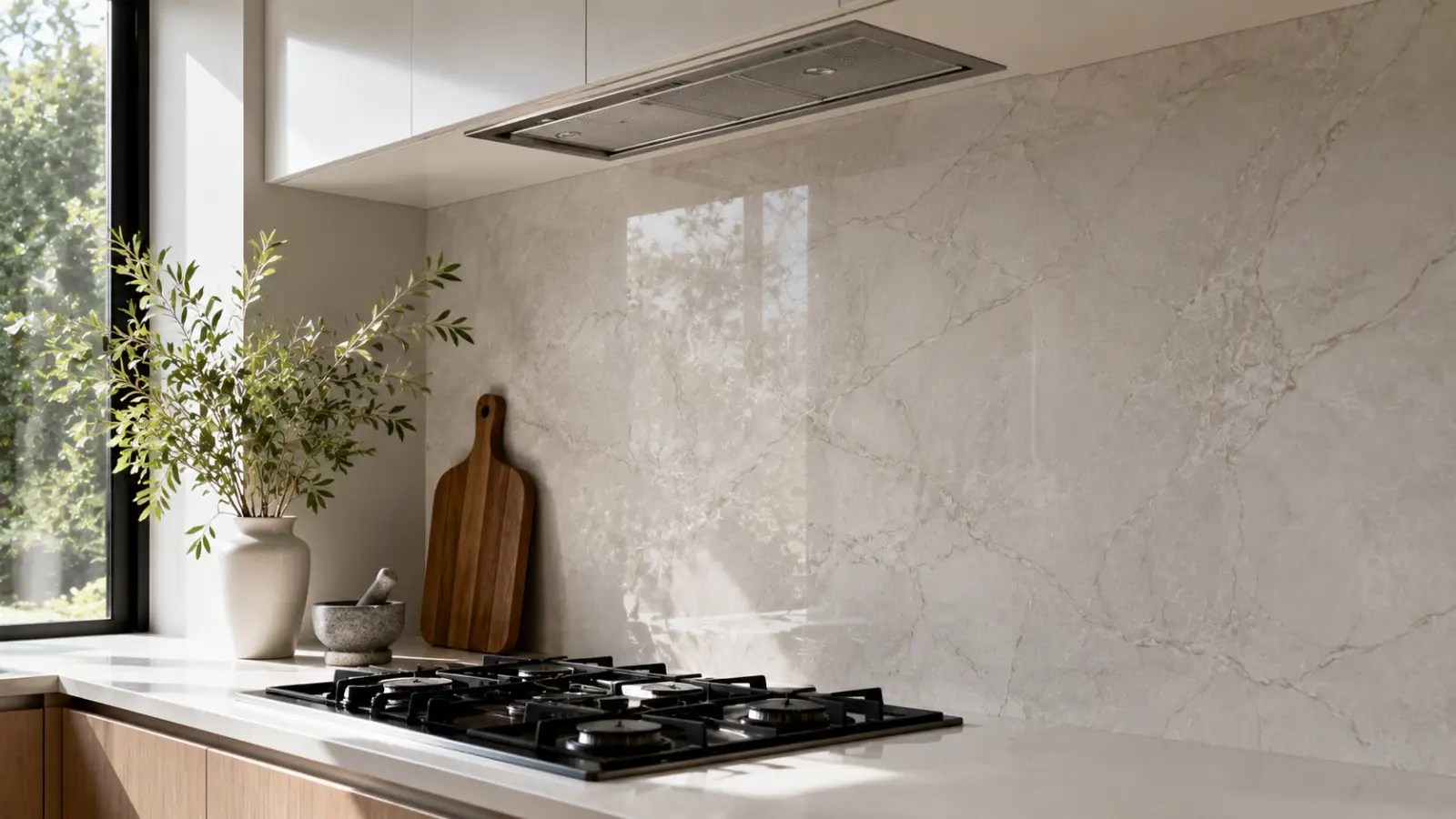
The splashback is one of the last things people think about when planning a kitchen, but it's the bit your eye lands on every time you stand at the bench. Get it right and the whole room feels resolved; get it wrong and it nags at you for years. So before you pick a colour off a sample board, it's worth understanding what each material actually asks of you.
Tiles: flexible and familiar, but mind the grout
Tiles are still the most common choice I see in Gisborne homes, and for good reason. You get an enormous range of colours, shapes and finishes, and they handle heat behind a gas hob without any drama. A classic subway tile suits villas and bungalows; larger-format tiles read more contemporary and give you fewer grout lines.
That word grout is the catch. Grout sits slightly proud of nothing and below everything, so it collects cooking grease and, in a humid coastal climate like ours, the odd patch of mould if the kitchen isn't well ventilated. A few honest pointers:
- Choose a grout colour close to the tile, or a mid-grey, rather than brilliant white that stains.
- Ask for an epoxy or sealed grout near the cooktop — it's far easier to wipe down.
- Skinny grout lines look sharp but show every imperfection, so the tiling needs to be tidy.
Tiles tend to sit at the more affordable end, though intricate patterns and fancy imported tiles can climb quickly once you add the tiler's labour.
Glass: seamless and easy to wipe
A toughened glass splashback is a single sheet with no joins and no grout, which makes it the easiest surface to keep clean — one wipe and you're done. It's painted on the back to whatever colour you like, so you can match it to your cabinetry or pick a soft neutral that bounces light around. In a darker Gisborne kitchen that natural light can make a real difference.
The trade-offs are worth knowing. Glass is measured and templated after your cabinetry and benchtop are installed, so it comes near the end and adds a wait. Cut-outs for power points have to be exact. And a bold gloss colour can look quite different on the wall than it does on a small sample, so I always suggest viewing a larger piece before you commit.
If wipe-clean simplicity matters most to you, a single sheet of back-painted glass is hard to beat — no grout, no joins, no fuss.
Stone slab: quiet luxury that ties the room together
Running your benchtop material up the wall as a stone slab splashback gives a calm, seamless look that's become really popular. Because the benchtop and splashback are the same stone, the colour and veining flow straight up the wall with no visual break, and there's no grout at all.
Most of these are engineered stone or porcelain rather than true granite, and they're robust against splashes and heat within reason. The cost sits at the higher end — you're paying for more of the same slab plus the fabrication — but if you already love your benchtop, continuing it upward is the most cohesive option there is. We often template the benchtop and splashback together so the grain lines up properly, which is the sort of detail that's easy to overlook on paper.
Full-height or standard? It changes the whole feel
Standard height runs roughly 450–600mm — from the benchtop up to the underside of your wall cabinets. Full-height carries the splashback all the way to the rangehood or up a wall where there are no overhead cupboards, which is increasingly common in open-plan Gisborne kitchens with a window or shelving instead of upper cabinets.
A few things to weigh:
- Full-height uses more material, so it adds cost — most with tiles, less so with a single glass sheet.
- It protects more wall behind a busy cooking zone and looks more deliberate.
- Behind a freestanding cooker, full-height is genuinely practical, not just decorative.
There's no wrong answer here; it comes down to your layout and budget.
Coordinating it all
The splashback shouldn't fight your benchtop and cabinetry — it should sit quietly between them. A safe approach is to let two of the three surfaces be calm and one carry the interest. If your benchtop has strong veining, keep the splashback simple. If your cabinetry is a bold colour, a neutral splashback lets it breathe.
Because we design, build and install in-house, we look at all three together from the start rather than choosing the splashback as an afterthought — and the same workshop standing behind it with our 5-year workmanship warranty means the join lines and cut-outs are held to one consistent standard.
Whichever way you lean, sit your samples together on the actual bench, in your own light, before you decide. That ten-minute habit saves a lot of second-guessing later.
Sukhman Singh
Founder & Cabinet Maker, Flow Joinery
Sukhman designs and builds bespoke kitchens, wardrobes and cabinetry across Gisborne. Read more →
Reviews
No reviews yet — be the first to share your thoughts.
Sign in or create an account to leave a review.