
Cabinet Materials Explained: MDF, Ply & Melamine

1 June 2026 · 4 min read
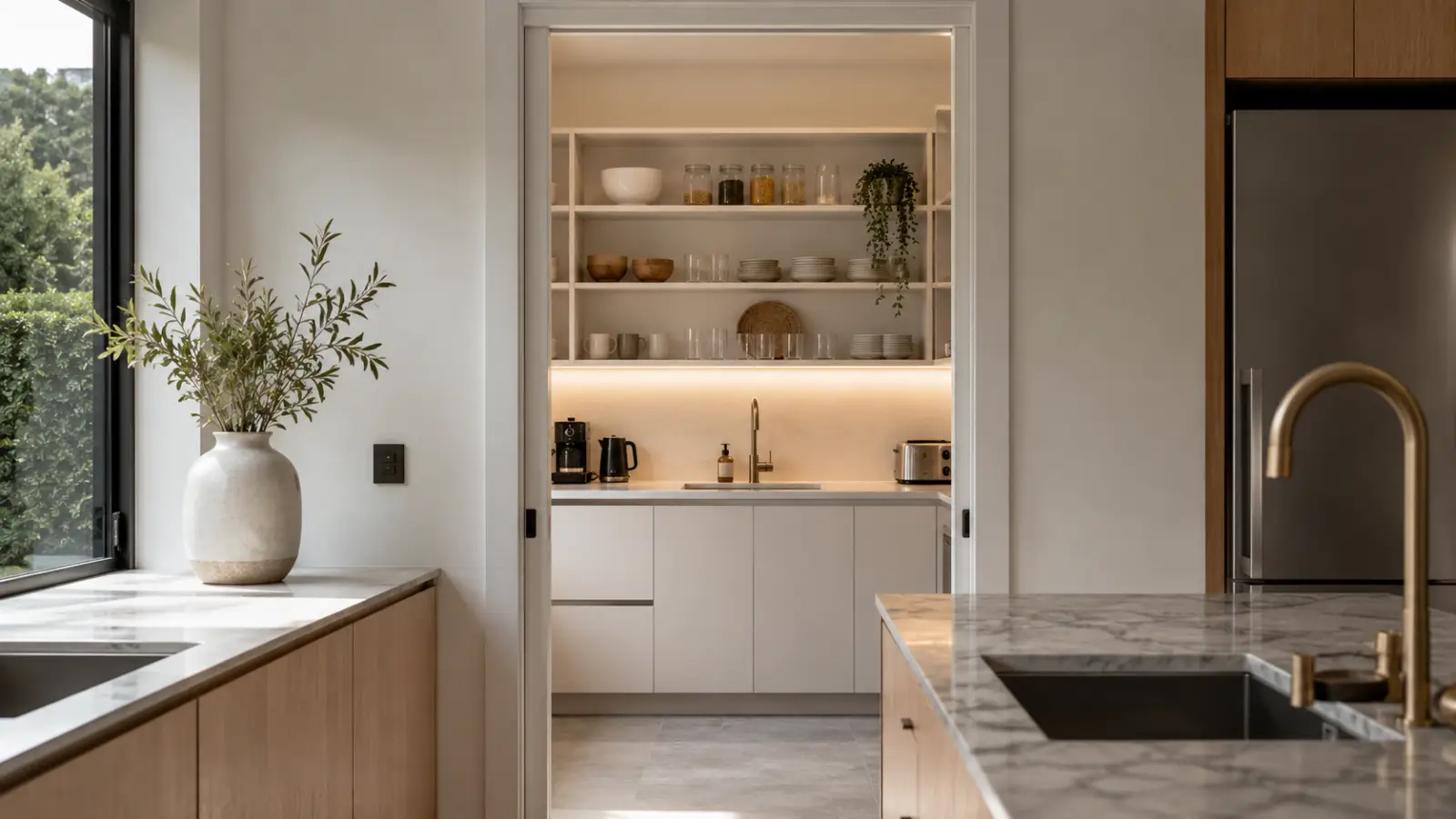
When someone walks into our workshop and runs a hand over a cabinet door, the first question is usually "is this real wood?" The honest answer is that most quality kitchens are built from engineered boards, and that's a good thing. The trick is knowing which board belongs where, because using the wrong one is how a kitchen looks tired in five years instead of twenty.
What These Materials Actually Are
Let me clear up the names, because they get muddled constantly.
- MDF (medium-density fibreboard) is wood fibre pressed with resin into a dense, smooth panel. No grain, no knots, perfectly flat.
- Plywood is thin veneers of real timber glued in alternating layers. Strong, light for its strength, and it holds a screw beautifully.
- Particleboard (sometimes called chipboard) is larger wood chips pressed with glue. It's the most economical board and forms the core of a lot of cabinetry.
- Melamine and laminate aren't structural boards at all. They're the hard-wearing surface bonded onto MDF or particleboard to give you colour and a wipeable finish.
So when a kitchen is described as "melamine," what's really meant is a particleboard or MDF core with a melamine face. Two different things doing two different jobs.
Moisture: The One That Matters Most in Gisborne
This is where I get firm with clients. Our climate swings from dry summers to humid, wet winters, and a kitchen lives next to sinks, dishwashers and steam.
Standard particleboard hates water. Once moisture gets into a raw edge or a failed seal, it swells and never recovers. That's why we use moisture-resistant (MR) board as standard for carcasses, and why we're careful about sealing every edge, especially around the sink and dishwasher cavity.
Plywood handles damp far better because of those cross-laminated layers, which is why it's my pick for laundry cabinets, anything in a bathroom, and the base unit under a sink.
The cheapest kitchen failure I see isn't a broken hinge. It's swollen particleboard under a sink that was never properly sealed.
Strength, Weight and Where Each Belongs
Each board has a job it does best, and matching them is most of what good cabinet making is.
Cabinet carcasses (the boxes themselves) are usually MR particleboard or MDF with a melamine face. It's stable, flat, affordable and the surface wipes clean. For a standard kitchen, this is the sensible, honest choice and there's no shame in it.
Plywood carcasses are the upgrade. Ply is lighter, holds fixings harder, and shrugs off moisture, so it suits wall cabinets carrying weight, open shelving, and wet areas. It costs more and the price has climbed, so I'll recommend it where it genuinely earns its keep rather than everywhere.
Doors and panels are where MDF shines. Because it has no grain, it takes a painted or sprayed finish with a flawless, glass-smooth result that solid timber can't match without movement over time. Most of our painted Shaker doors are MDF for exactly this reason.
Thermo-laminated (vinyl-wrapped) doors are MDF with a tough wrap heat-formed over the whole profile. Seamless and easy to clean, though I'd keep them away from the oven cavity since high heat can lift the edges over years.
Surfaces: Melamine, Laminate and the Real Differences
The finish is what you touch every day, so it's worth understanding.
Melamine is a thin decorative layer fused to the board under heat and pressure. Modern melamines look excellent, come in deep matt and woodgrain options, and handle daily knocks well. For most kitchens it's all the surface you need.
High-pressure laminate is thicker and tougher again, the sort of thing I'll steer you toward for a hard-working family kitchen or a benchtop edge that takes punishment.
Both are far more forgiving than a painted MDF door if you've got young kids, but painted MDF can be touched up down the track, while laminate can't. That trade-off, repairability versus toughness, is one of the most useful things to weigh up early.
How We Choose for Your Kitchen
There's no single "best" board, and anyone who tells you otherwise is selling something. A good kitchen usually mixes materials: MR particleboard or MDF carcasses, ply where moisture and load demand it, painted MDF doors for that crisp finish, and a durable melamine or laminate surface everywhere it makes sense.
Because we design, build and install everything ourselves here in Gisborne, we can match the board to the spot rather than ordering one flat-pack spec for the whole house. And every cabinet we make is backed by our 5-year workmanship warranty, which only works because we're honest about materials from the start.
If you're weighing up a new kitchen, bring your questions to the workshop. Understanding what's behind the doors makes every other decision easier.
Sukhman Singh
Founder & Cabinet Maker, Flow Joinery
Sukhman designs and builds bespoke kitchens, wardrobes and cabinetry across Gisborne. Read more →
Reviews
No reviews yet — be the first to share your thoughts.
Sign in or create an account to leave a review.